
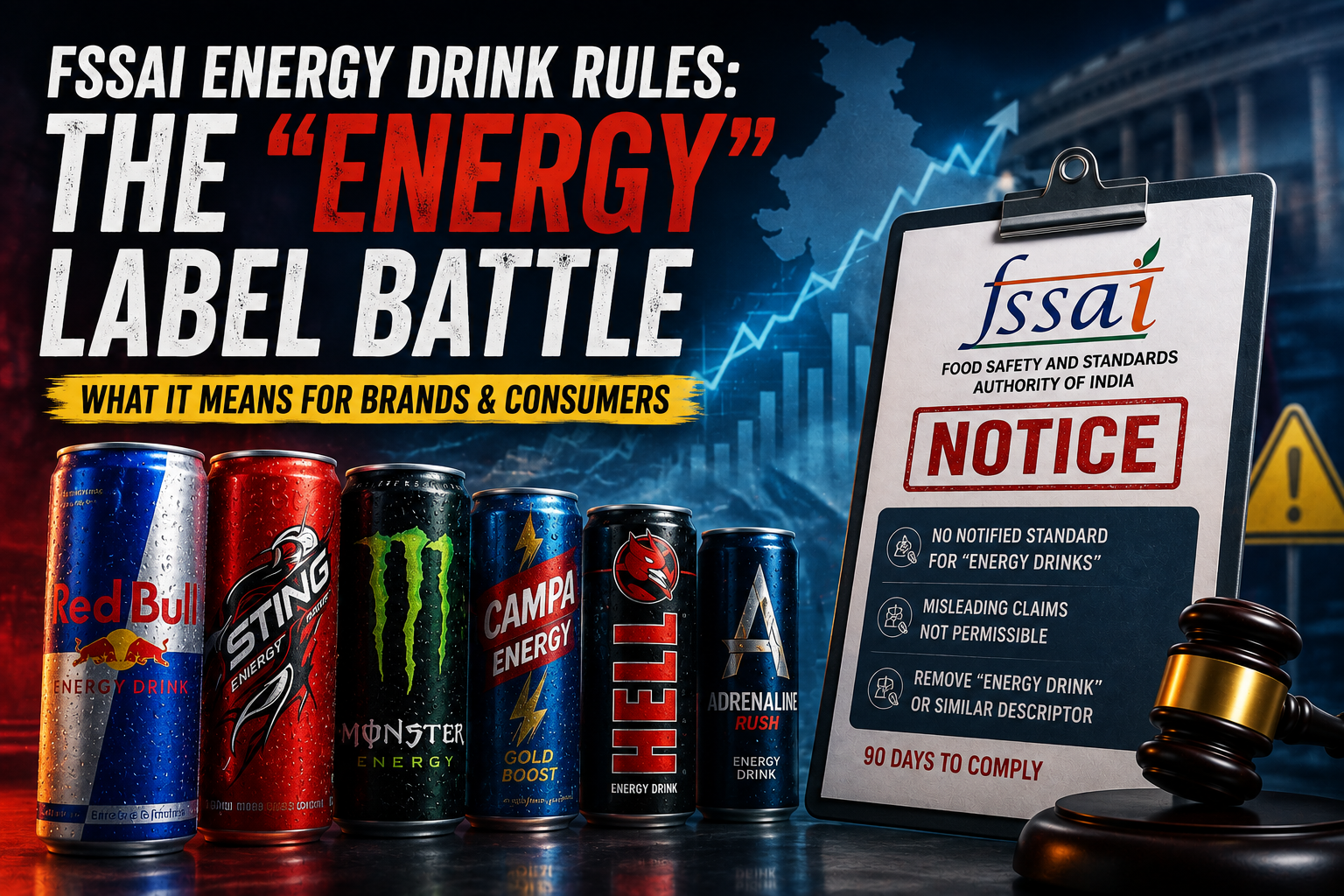
When One Word Becomes a ₹13,000-Crore Problem
What happens when the word that helped build an entire beverage category is suddenly the word a regulator wants removed?
That is exactly what is happening with “energy drink” in India.
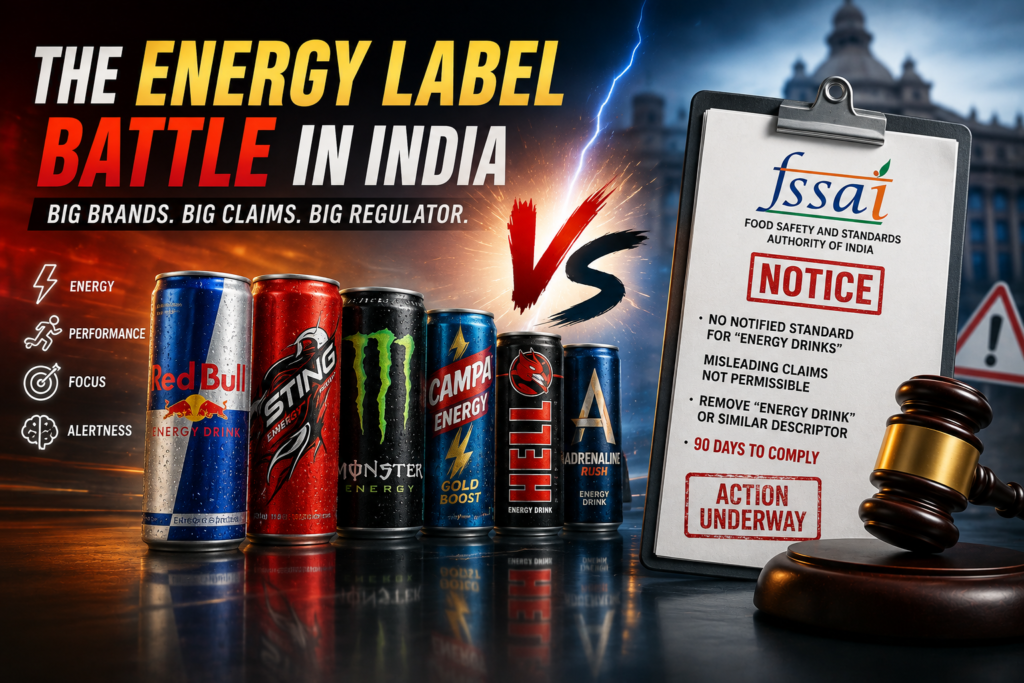
Brands such as Red Bull, Sting, Monster, Campa Energy, Hell Energy and PepsiCo’s Adrenaline Rush have built their positioning around speed, stamina, alertness and instant energy. Now, FSSAI is challenging the use of the category descriptor itself, saying India has no notified standard for “energy drinks” and that certain functional claims associated with these products are not permissible. Companies were given 90 days to comply. (Reuters)
That makes the FSSAI Energy Drink Rules story much bigger than a packaging update. It is a case study in what happens when regulation challenges the very language a category has used to sell itself.
What Actually Happened With FSSAI’s Energy Drink Action?
On July 1, 2026, FSSAI issued notices to six major beverage brands over what it described as misbranding and misleading claims.
The brands named in reporting were:
- Red Bull Energy Drink
- Sting Energy Drink
- PepsiCo’s Adrenaline Rush Energy Drink
- Reliance Consumer Products’ Campa Energy Drink–Gold Boost
- Hell Energy
- Monster Energy
FSSAI said India has not notified a specific standard for products marketed as “energy drinks” or similar products. It also objected to claims such as “vitalizes body and mind,” “enhances focus,” “boosts energy levels” and “aids in general weakness,” describing such functional or therapeutic claims as impermissible for food products. (Moneycontrol)
Then came the bigger move: companies were given 90 days to remove “energy drink” or similar descriptors from affected products. On August 7, Reuters reported that FSSAI had rejected industry requests for a one-year extension. (Reuters)
So this isn’t simply a notice asking brands to change an advertisement. It potentially affects the product name, packaging, advertising, retail listings and digital marketing.
Why Is FSSAI Questioning the “Energy” Label?
Here is where things get interesting.
FSSAI’s position is not that caffeine suddenly makes a beverage illegal. The dispute is about how the product is classified and what the marketing language promises.
FSSAI’s own FAQ describes energy drinks as generally non-alcoholic beverages containing ingredients such as caffeine, guarana, taurine, ginseng and B-vitamins. It also noted that there was no specific FSSAI standard for “energy drinks” at the time of that FAQ. (FSSAI)
At the same time, FSSAI’s food-category framework includes “so-called energy drinks” within the broader category of carbonated water-based flavoured drinks. That distinction matters: a food-category classification is not necessarily the same thing as an authorised product name or marketing claim. (FSSAI)
In other words, the regulator’s argument is essentially:
The beverage can exist. The question is whether “energy drink” is an appropriate regulated identity for it—and whether the claims attached to that identity are allowed.
That is what makes the FSSAI Energy Drink Rules issue particularly interesting for marketers.
Which Energy Drink Brands Are Affected?
The initial notices covered six major players, but the implications extend beyond those names.
Why?
Because this is not really a PepsiCo-versus-FSSAI story or a Red Bull-versus-FSSAI story. It is a category-level branding issue.
And the category is significant. Reuters reported that India’s energy-drink retail sales were growing around 12.6% annually, with the market projected to reach about $1.6 billion by 2028. (Reuters)
That means even a seemingly small labelling change can create a surprisingly large commercial ripple.
The Real Problem: When a Category Name Becomes a Brand Asset
This is where the FSSAI Energy Drink Rules become a marketing story.
Think about how these products are sold.
A consumer sees the can.
The colour grabs attention.
The brand name creates recognition.
The words “Energy Drink” immediately tell the consumer what category the product belongs to.
Then advertising reinforces the promise:
energy → performance → alertness → action.
Take that category descriptor away, and suddenly the brand has to work harder to answer a very basic question:
“So, what exactly is this product?”
That is a serious positioning challenge.
Red Bull’s own Indian product communication has historically used the “Energy Drink” descriptor and the “Vitalizes body and mind” claim, while its marketing ecosystem extends into sports, music and motorsports. (Red Bull)
Sting has built a different but equally powerful identity around affordable, high-energy positioning. Reuters reported that its Indian advertising has used “electrifying energy” imagery, while its Formula 1 sponsorship had promoted it as the sport’s official energy drink. (Reuters)
So the regulatory challenge isn’t merely:
“Remove two words from the can.”
It is:
“Remove two words without removing the mental association that made people buy the can.”
What Is Happening to Sting and Why Marketers Should Watch It
PepsiCo provides the clearest real-world example of what this transition looks like.
According to Economic Times, PepsiCo India has already started manufacturing new Sting cans and bottles without the word “energy”. The company is also reworking Sting advertising, including communication connected with its Formula 1 sponsorship. PepsiCo said it was ensuring compliance with applicable regulations. (The Economic Times)
That is a fascinating branding problem.
The product remains recognisable because the Sting name, colour, packaging style and visual identity still carry equity.
But the category descriptor is changing.
This demonstrates an important marketing principle:
Strong brands should be recognisable even when one generic product descriptor disappears.
If removing one phrase makes a brand difficult to understand, too much of its positioning may have been built around the category rather than the brand itself.
What Does This Mean for Consumers?
The immediate question is obvious:
Is FSSAI banning energy drinks?
No blanket ban on energy drinks has been announced.
The current action is focused on the use of the “energy drink” descriptor and related functional or therapeutic claims, rather than declaring every affected beverage unsafe. (Reuters)
But consumers could notice changes at the shelf and online.
Rajasthan has already seized thousands of Sting, Campa Energy and Red Bull products as part of enforcement, while authorities in Ladakh said seizure action was part of district-level inspections. Rajasthan also instructed e-commerce platforms not to promote such products as “energy drinks.” (Reuters)
So the regulatory chain can quickly become:
FSSAI action → packaging change → retailer confusion → marketplace changes → search confusion → consumer questions.
And that is where compliance becomes a marketing issue.
The Business Impact: Bigger Than a Label Change
The FSSAI Energy Drink Rules create three immediate business challenges.
1. Packaging and inventory
Brands may have millions of cans, bottles and printed packaging already in circulation. Industry representatives have asked for more time partly because replacing packaging at scale is expensive and operationally difficult. (Reuters)
2. Marketing disruption
The disputed language can appear everywhere:
- packaging
- TV and digital advertisements
- websites
- e-commerce listings
- social media
- influencer briefs
- sponsorships
- retail displays
Changing one phrase therefore means auditing an entire communication ecosystem.
3. Brand-equity risk
This is the most important part.
If consumers associate a product with “energy drink”, removing the descriptor can create a temporary gap between what they remember and what they see.
The brand must then replace that lost meaning with something stronger.
How Should Energy Drink Brands Respond?
Simply deleting the word “energy” is the weakest possible strategy.
A smarter response would look like this:
1. Build a new compliant product descriptor.
The product name, flavour, format and distinctive visual identity should do more of the category communication without relying on restricted terminology.
2. Shift from broad benefit claims to verifiable product attributes.
Instead of building campaigns around unsupported promises, brands can focus on permissible, substantiated characteristics.
3. Protect distinctive brand assets.
Colours, typography, packaging shape, music, sports associations and other recognisable codes can maintain brand recall.
4. Rework search and e-commerce strategy.
Consumers will continue searching for terms such as “best energy drink” and “energy drink in India.” Brands need compliant product pages and marketplace listings that address search intent without making prohibited or misleading claims.
5. Coordinate every channel.
The new message on the bottle should match the website, social media, advertisements, influencer campaigns and retailer listings.
That is the real strategic challenge behind the FSSAI Energy Drink Rules:
How do you change the label without changing the brand in the consumer’s mind?
What Can Other Beverage Brands Learn?
The FSSAI Energy Drink Rules dispute offers a useful warning for the entire FMCG industry.
Brands should audit their complete claim architecture:
Product name → packaging → advertising → influencer scripts → marketplace listings → sponsorships → consumer promise.
If the same generic word appears everywhere, it can become a single point of regulatory vulnerability.
There is another lesson too: brand equity should sit deeper than category terminology.
A strong brand should survive a change in vocabulary.
If consumers remember only “energy drink”, the category owns the relationship.
If they remember the brand, taste, experience, visual identity and reason to choose it, the brand owns the relationship.
What Happens Next?
As of August 13, 2026, the 90-day compliance window remains the central deadline. Reuters reported that FSSAI rejected requests from major companies including PepsiCo, Red Bull, Monster and Reliance for a one-year extension. (Reuters)
The industry has also pushed for greater consultation, while companies face the practical challenge of managing existing inventory and packaging.
PepsiCo has already moved ahead with new Sting packaging, showing that at least one major player is treating the change as an implementation problem rather than waiting indefinitely for a reversal. (The Economic Times)
The next phase will reveal whether brands simply rename their products—or use the disruption to rethink how they position them.
The Bigger Marketing Lesson
The FSSAI Energy Drink Rules are ultimately a lesson in brand dependency.
If one word carries your product category, advertising promise, search visibility and consumer expectation, losing that word can expose how dependent the entire marketing strategy has become on it.
The smartest brands won’t treat this as a compliance exercise.
They’ll treat it as a positioning challenge.
Because when a regulator changes the vocabulary, a brand has two choices:
Keep defending the old label—or build a stronger reason for consumers to remember the product without it.
And that may be the most valuable lesson to come out of India’s “energy” label battle.
FAQs
What are the FSSAI Energy Drink Rules about?
FSSAI has directed affected beverage companies to remove “energy drink” or similar descriptors from high-caffeine beverages, citing the absence of a notified Indian standard for the category and concerns over related functional or therapeutic claims. (Reuters)
Which energy drink brands are affected by FSSAI action?
The brands named in reporting include Red Bull, Sting, Adrenaline Rush, Campa Energy Drink–Gold Boost, Hell Energy and Monster Energy. (The Economic Times)
Is FSSAI banning energy drinks in India?
No. The current action focuses on product descriptors, labelling and related claims rather than a blanket ban on the beverages themselves. (Reuters)
Why is FSSAI removing the “energy drink” label?
FSSAI says India does not have a notified standard for “energy drinks” and has objected to certain functional or therapeutic claims associated with the category. (Moneycontrol)
Will Sting still be sold in India?
PepsiCo has started manufacturing new Sting cans and bottles without the word “energy” and is reworking related advertising. The regulatory transition is ongoing. (The Economic Times)
Will the new rules change the actual drink?
The current regulatory action is primarily about labelling, product descriptors and claims. It does not amount to a blanket order requiring all affected beverages to change their formulation. (Reuters)
What should energy drink brands do now?
Brands should audit their product claims, packaging, advertising, digital listings and sponsorship communication; develop compliant positioning; and protect distinctive brand assets while the transition takes place.
Want to see how regulatory scrutiny can turn into a major branding challenge? Read our case study on FSSAI vs Alcohol Brands: India’s New Spirit Label Rules
For more real-world marketing insights, brand case studies and industry trends, follow SkillUpLemon on Instagram