
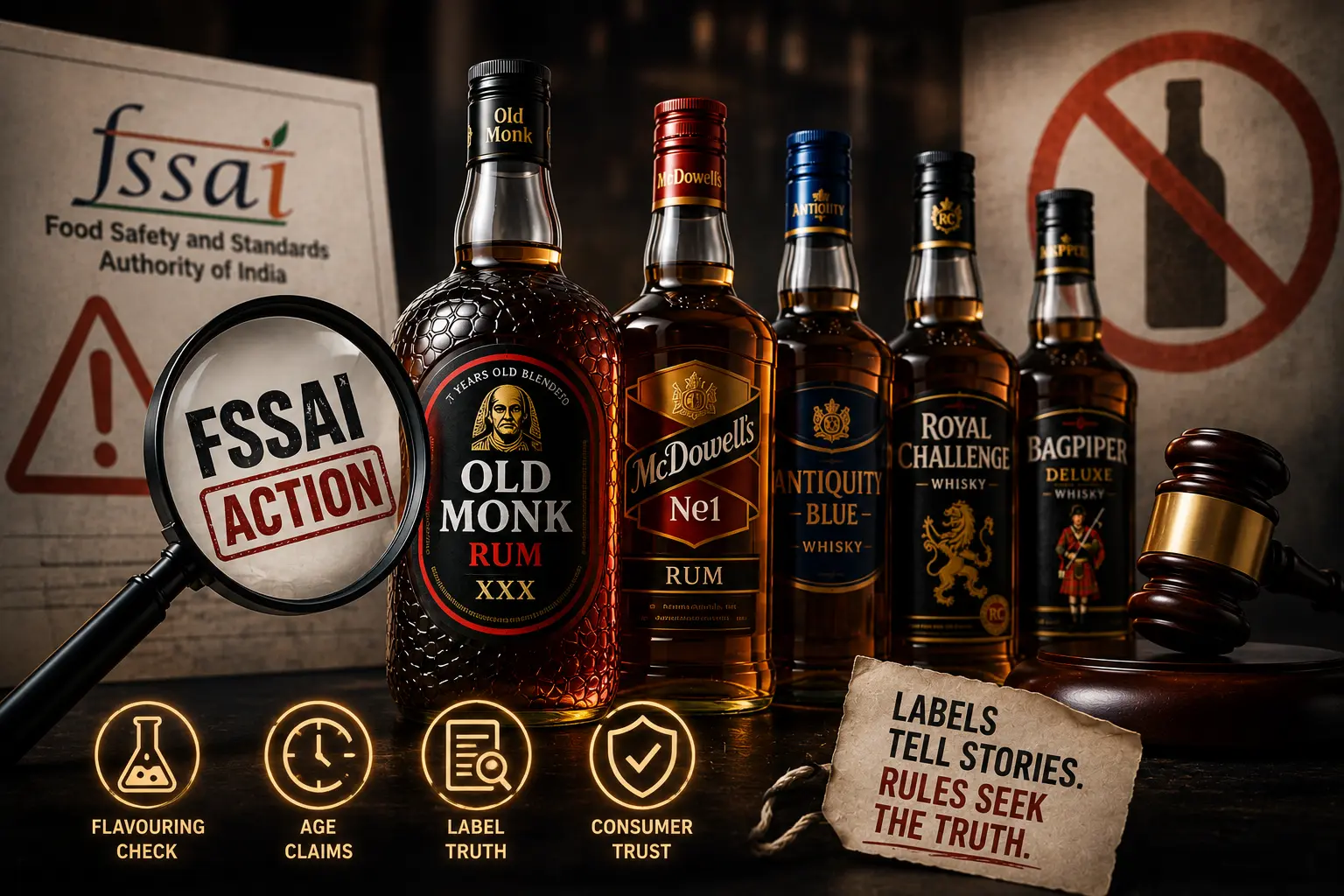
Why India’s Biggest Spirit Brands Are Under Scrutiny
What if the most valuable words on a liquor bottle—“matured”, “aged” or “oak”—suddenly became the words a regulator questioned?
That is the real story behind the action involving Old Monk, McDowell’s No.1, Royal Challenge, Antiquity Blue and Bagpiper. This is not a contamination scandal or blanket ban on alcohol. It is a dispute over flavouring, product identity, ageing claims and whether the story on the bottle matches the liquid inside it.
That makes the FSSAI alcohol rules controversy a case study in what happens when regulation collides with marketing and brand trust.
What Actually Happened?
In July 2026, FSSAI issued notices over added flavours and age-related claims. In early August, it moved against selected products from United Spirits/Diageo India, Inbrew and Mohan Meakin-linked production, including McDowell’s No.1 Rum, Royal Challenge Whisky, Antiquity Blue Whisky, Bagpiper Deluxe Whisky, Old Cask Deluxe XXX Rum and specified Old Monk variants.
The key word is selected. This was not a blanket ban.
Why Did FSSAI Take Action?
At the centre of the FSSAI alcohol rules dispute is added flavouring that, according to FSSAI, can reproduce the characteristic taste or aroma of spirits such as rum or whisky.
The Food Safety and Standards (Alcoholic Beverages) Regulations, 2018 set standards for product characteristics and labelling. FSSAI said some manufacturers were using added flavours to mimic natural profiles.
For blends, the declared age must refer to the youngest spirit used. That makes “aged” more than attractive packaging language; it carries a regulatory meaning.
FSSAI also questioned an Old Monk age-related claim after reported testing indicated a small matured-rum component alongside much more neutral spirit.
So the real question isn’t simply “Are artificial flavours banned?” It is: Does the formulation and label accurately tell consumers what they are buying?
Old Monk, McDowell’s No.1 and Royal Challenge: What Is Actually Affected?
Is Old Monk banned in India? No, not as an entire brand.
Reported action concerns specified Old Monk variants and manufacturing contexts. Other products carrying the master brand are not automatically covered.
McDowell’s No.1 faces a similar distinction. United Spirits has challenged the prohibition involving McDowell’s No.1 Celebration Matured XXX Rum made in Maharashtra. The company says its labels comply with applicable laws and is contesting the action in court.
Royal Challenge and Antiquity Blue were also affected in the wider action involving specified production in Madhya Pradesh. Separately, FSSAI questioned Royal Challenge’s “matured in American oak casks” claim, saying most of the spirit was not matured and questioning the label’s use of “Scotch”.
For marketers, “matured in American oak casks” is a quality signal that influences premium positioning.
When Regulation Becomes a Marketing Problem
Here is where the FSSAI alcohol rules become bigger than a compliance checklist.
A liquor label does three jobs: it identifies, explains and sells the product.
Think about the chain:
Formulation → label claim → consumer expectation → brand perception → purchase decision
If consumers associate “matured” with craftsmanship and quality, a dispute over what “matured” actually means can affect more than packaging. It can affect authenticity.
That makes this a brand-management case study: heritage and familiarity are part of a spirit brand’s equity, so a product-claim challenge can become a consumer-confidence problem.
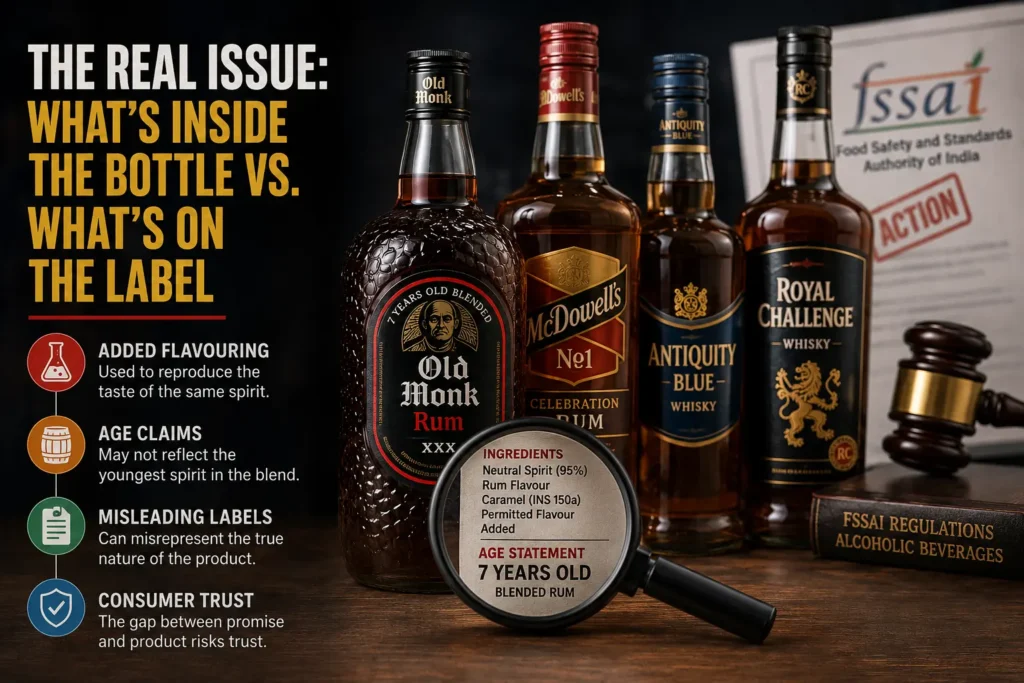
FSSAI vs Alchohol Brands : Who Says What?
FSSAI says the affected products do not comply with applicable standards relating to flavouring and/or labelling. United Spirits says its labels comply with current laws and has challenged the McDowell’s prohibition, including aspects of the regulatory process.
The Bombay High Court has heard the challenge but has not finally decided the dispute; Reuters reported that the court sought the federal government’s response by August 19, 2026.
So readers should keep three things separate: FSSAI’s findings, the companies’ defence and the court’s final decision.
The Business Impact: More Than a Stop-Sale Order
A restriction can mean held inventory, distributor confusion and packaging reviews. But the bigger risk is brand uncertainty. Once consumers ask, “What exactly am I paying for?”, the issue has moved into marketing.
Competitors may also see an opening through clearer product identity and transparent maturation.
How Should Alcohol Brands Respond?
The smartest response is not simply “change the label”.
1. Audit the entire product story. Review formulation, flavouring, maturation records, age claims, packaging and advertising together.
2. Decide whether to reformulate or reposition. Reformulation may change the taste consumers know; where legally appropriate, clearer classification and relabelling may be another route.
3. Protect the master brand. A problem with one SKU should not become a portfolio-wide crisis. Clearly communicate which products are affected.
4. Manage the crisis as a brand. Silence creates rumours; aggressive denial can sound defensive. Use acknowledge → clarify → explain → update.
5. Own the search results. For queries such as “Is Old Monk banned?”, an official clarification page plus consistent retailer and social communication can reduce confusion.
This is where the FSSAI alcohol rules become a digital reputation issue too—and a search-reputation issue for the brand.
What Can Other Alcohol Brands Learn?
The FSSAI alcohol rules dispute offers five lessons: product claims are marketing assets and compliance risks; packaging is part of the sales pitch; heritage cannot substitute for evidence; compliance belongs in product development; and transparency can become a competitive advantage.
The smarter question is: Do the product, proof, packaging and promise tell the same story?
What Happens Next?
The legal picture is developing. United Spirits is challenging the McDowell’s prohibition, while other affected companies have also taken legal steps, according to reporting.
Separately, Reuters reported the seizure of around 18,000 boxes of Diageo liquor bottles over missing markings related to recycled-PET packaging compliance. United Spirits said the bottles came from an FSSAI-approved recycler and had undergone required testing.
The broader lesson from the FSSAI alcohol rules dispute: labels, packaging, claims and documentation can all become regulatory pressure points.
The Bigger Lesson for India’s Alcohol Industry
The FSSAI alcohol rules episode ultimately comes down to something every marketer understands: a brand promise only works when consumers believe it.
Words such as aged, matured, reserve and oak help shape perceived quality and positioning. Once those words influence consumer expectations, they become part of the product promise.
For affected brands, the priority is to align product formulation, evidence, packaging, distribution and marketing communication.
The real question isn’t whether a bottle can stay on the shelf. It is whether its story can survive scrutiny—and still earn consumer trust.
FAQs
Is Old Monk banned in India?
No blanket ban on the entire Old Monk brand has been established. The action concerns specified products and manufacturing contexts.
Why was McDowell’s No.1 affected?
FSSAI raised concerns about McDowell’s No.1 Celebration Matured XXX Rum. United Spirits is challenging the prohibition.
Does FSSAI ban all artificial flavours in alcohol?
No. The issue concerns flavouring used to mimic the characteristic taste or aroma of the same beverage where FSSAI says the practice does not comply.
What can brands do next?
Audit formulations and claims, assess reformulation or relabelling, strengthen documentation and communicate clearly while the legal position develops.
Why does this matter to alcohol marketers?
Because words such as “matured”, “aged” and “oak” can influence perceived quality and price positioning. If regulators challenge those claims, a compliance dispute can quickly become a brand-trust problem.
Sources & References
- FSSAI — Food Safety and Standards (Alcoholic Beverages) Regulations
- FSSAI — Alcoholic Beverages Regulations & Amendments
- Reuters — India bars some Diageo, Inbrew liquor over artificial flavouring
- Reuters — Diageo challenges India rum ban over due process
- Reuters — Royal Challenge maturation and Scotch labelling warning
- Reuters — Diageo bottle seizure over recycled-PET markings
For more real-world marketing insights, brand case studies, and industry updates, follow SkillUpLemon on Instagram