
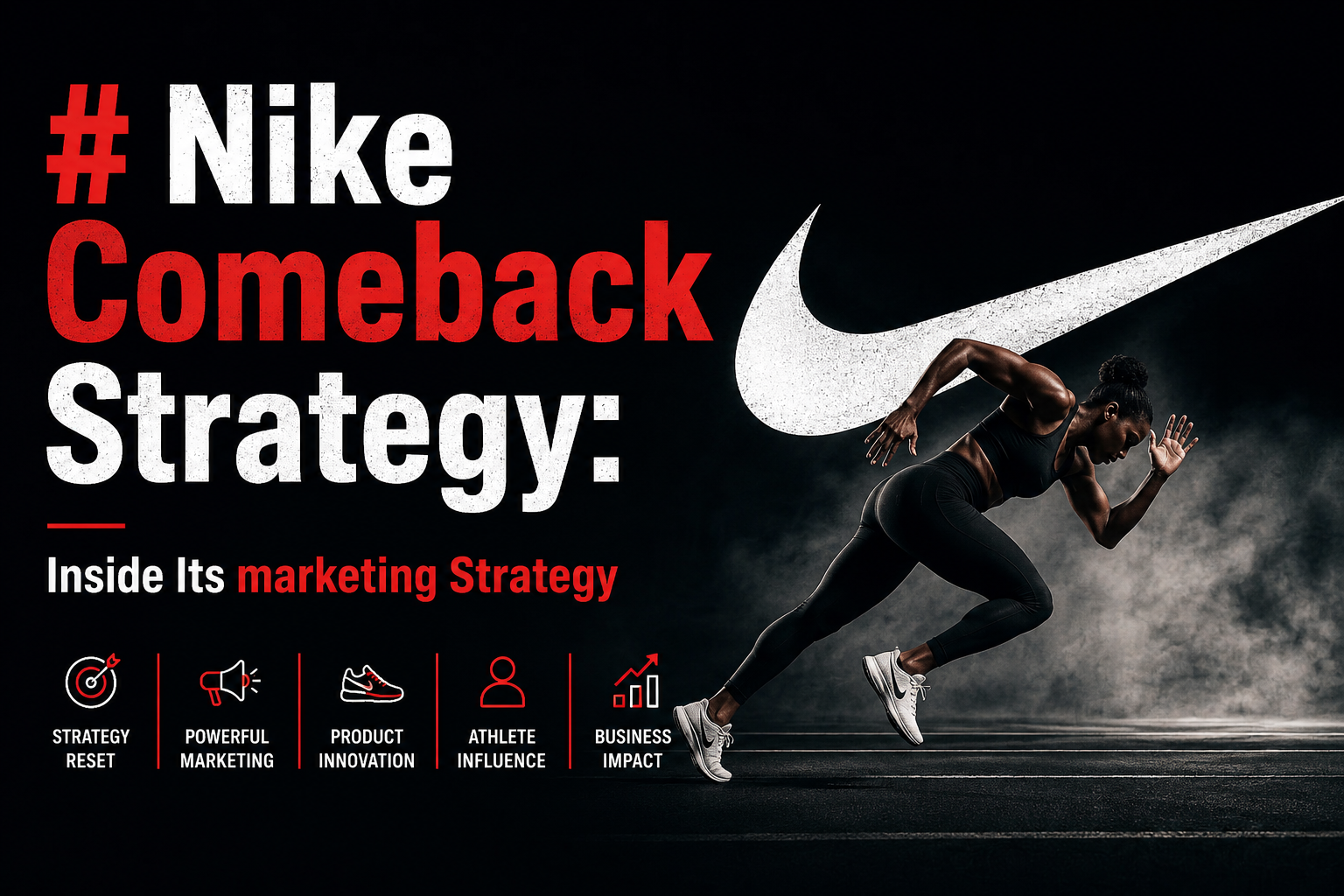
For decades, Nike had one of the clearest positions in the sports industry: Nike understood sport, understood athletes, and knew how to turn athletic ambition into culture.
But that advantage started to weaken.
Nike entered a difficult period of slowing sales, heavy discounting, weaker product momentum and growing competition from brands such as HOKA, On and other performance-focused challengers. Its fiscal 2025 revenue fell 10% to $46.3 billion, while NIKE Direct revenue declined 13% and Nike Brand Digital fell 20%.
Then came a major leadership change.
In October 2024, former Nike veteran Elliott Hill returned as President and CEO, replacing John Donahoe. His message was straightforward: nike had to get back to what made it great — sport and the athlete.
That became the foundation of Nike’s comeback strategy.
But this isn’t simply a story about better advertising.
It is a story about reconnecting product, athletes, storytelling, innovation, retail and brand culture around sport again.
And Nike’s comeback is still a work in progress.
Nike’s Comeback: What Went Wrong?
Nike’s problem wasn’t that people suddenly stopped knowing the brand.
Everyone knew Nike.
The problem was that the brand’s advantage was becoming less distinctive in several categories, particularly as competitors built strong identities around running, comfort and performance.
At the same time, Nike had made strategic shifts that moved parts of the business away from its traditional sport-first identity.
Elliott Hill acknowledged the issue directly, saying Nike had “lost our obsession with sport” and that the company needed to put the athlete back at the center of its decisions.
That diagnosis is important.
Nike didn’t need to invent a completely new identity.
It needed to recover the identity that had made it successful in the first place.
The Numbers Behind the Problem
Nike’s FY2025 results show how serious the reset had become:
| Metric | FY2025 result |
| NIKE, Inc. revenue | $46.3B |
| Revenue change | -10% |
| NIKE Direct revenue | $18.8B |
| NIKE Direct change | -13% |
| Nike Brand Digital | -20% |
| Wholesale revenue | $25.9B |
| Gross margin | 42.7% |
The challenge was therefore bigger than marketing.
Nike needed better products, healthier inventory, stronger retail relationships and renewed consumer demand.
That is where the comeback strategy begins.
The Turning Point: Elliott Hill Returns to Nike
Elliott Hill wasn’t an outsider brought in to completely reinvent Nike.
He was a longtime Nike executive who had spent more than three decades with the company before retiring in 2020. The board brought him back in 2024 because of his deep understanding of Nike, its athletes, products, partners and culture.
His return created an important strategic signal:
Nike was going back to its roots.
Instead of treating sport as one category among many, the company began reorganizing around sports such as running, basketball and global football.
Nike calls this new operating model its Sport Offense.
The idea is simple:
Understand the athlete first. Build the product, innovation and storytelling around that athlete.
Nike says the structure allows teams to develop deeper insights into individual sports and use those insights to influence both innovation and storytelling.
This is a significant change from simply asking, “What product should we sell?”
The better question becomes:
“What problem does this athlete have, and how can Nike solve it?”
Strategy 1: Put the Athlete Back at the Center
Nike’s most important comeback move isn’t a new slogan.
It’s a change in the company’s strategic filter.
The athlete is supposed to influence everything from product development to marketing.
Nike’s new Sport Offense organizes teams around specific sports, allowing them to understand the needs of different athletes rather than treating the entire market as one audience.
That matters because a basketball player, marathon runner and footballer don’t want the same thing.
Their motivations are different.
Their performance problems are different.
Their communities are different.
And therefore, their stories should be different too.
This approach gives Nike a chance to move from broad celebrity-led marketing toward sport-specific relevance.
Strategy 2: Emotional Storytelling — But With a Purpose
This is where the original idea behind this case study becomes powerful.
Nike has always been better at selling a feeling than selling a shoe.
The product matters, but the story surrounding the product gives it meaning.
Nike’s recent marketing continues this tradition.
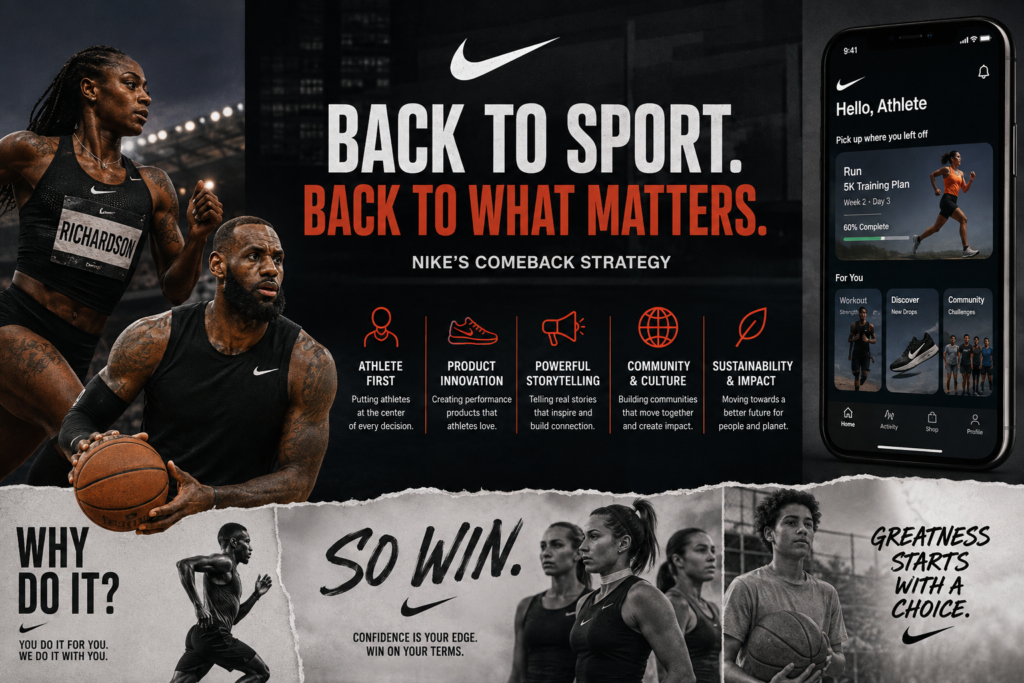
In February 2025, Nike launched “So Win” during Super Bowl LIX. The campaign featured athletes including Caitlin Clark, Jordan Chiles, Sabrina Ionescu, Sha’Carri Richardson and A’ja Wilson.
The message wasn’t simply about winning medals.
It focused on confidence, ambition and pushing through expectations placed on athletes. Nike explicitly positioned the athlete’s voice at the center of its storytelling.
That distinction is important.
Nike isn’t saying:
“Here is our new product.”
It’s saying:
“Here is what this athlete is trying to overcome and here’s why that matters to you.”
The product then becomes part of the story.
That is the real power of Nike’s storytelling strategy.
Strategy 3: Turning “Just Do It” Into a New Generation’s Story
Nike’s greatest marketing asset is also one of its biggest challenges.
“Just Do It” is iconic.
But how do you make a decades-old message relevant to someone discovering the brand today?
Nike’s answer was not to abandon it.
It was to reinterpret it.
In September 2025, Nike introduced its “Why Do It?” campaign, designed to connect “Just Do It” with a younger generation.
Instead of presenting greatness as something reserved for elite athletes, the campaign framed greatness as a choice something that begins when someone decides to start.
That shift is subtle but strategically important.
The old message was:
Just Do It.
The new question becomes:
Why do you do it?
That gives younger consumers room to attach their own meaning to Nike’s philosophy.
For one person, it could mean winning.
For another, getting through their first run.
For someone else, simply showing up.
Nike isn’t changing the core idea.
It is changing the context around it.
Strategy 4: Product Innovation Has to Support the Story
A comeback cannot survive on advertising alone.
Nike knows this.
If the brand promises athletes better performance, the products have to deliver. That’s why product innovation has become another major part of the reset.
In 2025, Nike announced a new athlete-focused innovation engine bringing Nike, Jordan Brand and Converse innovation and product teams closer together. The company also introduced platforms including Aero-FIT, Air Milano, Nike Mind and Project Amplify.
This is where Nike’s marketing strategy connects with business strategy.
Storytelling creates attention.
Innovation gives consumers a reason to believe the story.
A powerful campaign can bring someone back to Nike once.
A genuinely better product can bring them back repeatedly.
Strategy 5: Rebuilding the Marketplace
Another major lesson from Nike’s comeback is that digital-first doesn’t mean digital-only.
Nike had invested heavily in its Direct business and digital ecosystem, but the company is now placing greater emphasis on marketplace balance and wholesale partnerships.
The numbers show the shift.
In FY2026, Nike’s wholesale revenue increased 6% to $27.5 billion, while NIKE Direct revenue declined 6% to $17.7 billion. This doesn’t mean Nike is abandoning Direct-to-Consumer.
It means the company is trying to create a healthier combination of:
- Nike-owned stores
- Nike digital platforms
- Wholesale partners
- Sport-specific experiences
- Physical retail
The goal is simple: Be where athletes actually shop and participate in sport.
That is a more practical approach than treating every customer interaction as a reason to push them into Nike’s own ecosystem.
Strategy 6: Make Athletes the Media
Nike’s strongest storytelling asset isn’t a studio, it’s its athlete network. Instead of using athletes only as product endorsers, Nike can use their journeys as content.
That includes moments of:
- Failure
- Recovery
- Competition
- Confidence
- Pressure
- Identity
- Achievement
This is why athletes such as Serena Williams and LeBron James have been so valuable to Nike over the years. Their stories extend beyond sport.
Serena represents resilience and reinvention. LeBron’s work in education and community development adds another dimension to his public identity.
The strategic lesson is clear:
Nike doesn’t need athletes simply to tell people what to buy. It needs them to give the brand something worth talking about.
That makes the athlete part of the brand narrative rather than just an advertising asset.
Strategy 7: Sustainability Has to Be Backed by Action
Nike’s sustainability messaging is another important part of its brand positioning, particularly as consumers pay greater attention to how products are made.
Its Move to Zero initiative focuses on reducing carbon emissions and waste, while Nike continues to invest in lower-impact materials and manufacturing processes.
Nike’s sustainability reporting also provides measurable progress. For example, Nike reported a 69% reduction in absolute Scope 1 and 2 emissions from its operations in FY2024 compared with its FY2020 baseline, along with a 36% reduction in Scope 3 emissions from manufacturing and transportation. This matters because sustainability cannot simply exist inside a campaign. If Nike wants consumers to trust the story, the business has to support it with measurable action.
Is Nike’s Comeback Working?
This is where the story gets interesting.
The answer is: partially.
Nike has not completed its comeback. But some indicators have improved.
By FY2026, total Nike revenue had stabilized at $46.4 billion, compared with $46.3 billion in FY2025. Wholesale revenue grew 6%, while North America provided some growth that helped offset weakness in Greater China and EMEA. However, NIKE Direct revenue was still down 6%, Nike Brand Digital declined 12% in the fourth quarter, and Converse revenue fell 31% for the full year. So declaring Nike’s comeback “complete” would be misleading.
The more accurate conclusion is:
Nike has moved from decline management toward recovery, but the turnaround still has significant work ahead.
That makes the story more valuable for marketers. Because real business turnarounds rarely happen overnight.
What Nike’s Comeback Strategy Teaches Marketers
Nike’s biggest lesson isn’t simply “use emotional storytelling.” That would be too shallow.
The bigger lesson is that marketing works best when the story reflects a real strategic change inside the business.
Nike’s current reset connects several moving parts:
| Business challenge | Nike’s response |
| Lost connection with sport | Sport-first operating model |
| Weak product momentum | Athlete-led innovation |
| Brand fatigue | Renewed storytelling |
| Growing competitors | Stronger sport-specific focus |
| Wholesale weakness | Reinvestment in retail partners |
| Digital slowdown | Marketplace diversification |
| Changing consumer expectations | Sustainability + purpose |
| Aging slogan | “Why Do It?” reinterpretation |
That is why Nike’s comeback is more than a campaign.
It is a business-wide repositioning.
The Biggest Mistake Brands Should Avoid
There is an easy lesson to take from Nike: “Tell emotional stories.”
But that’s not enough.
A smaller brand cannot copy Nike simply by producing an inspirational video with an athlete. The storytelling has to come from somewhere real. Nike has decades of athlete relationships, product innovation, cultural relevance and brand equity behind its campaigns.
For other businesses, the equivalent could be:
- A founder’s journey
- A customer’s transformation
- A product problem that was genuinely solved
- An employee’s experience
- A community the brand helped build
- A failure that changed the business
The story should come from the business — not be pasted onto it.
What Could Make or Break Nike’s Comeback?
Nike still has several challenges ahead.
Competition from brands such as HOKA and On remains intense, particularly in performance running. The company also continues to deal with weakness in Greater China, pressure on its Direct business and broader consumer affordability concerns.
The biggest question is therefore not:
“Can Nike create another viral campaign?”
Nike already knows how to do that.
The real question is:
“Can Nike consistently turn its renewed focus on sport into products and experiences that athletes genuinely prefer?”
If the answer is yes, the marketing becomes much more powerful.
If the products fail to keep up, storytelling alone won’t save the turnaround.
Final Verdict: Nike’s Comeback Is Bigger Than Marketing
Nike’s current strategy is best understood as a return to fundamentals.
The company is putting sport back at the center, reorganizing teams around athletes, investing in product innovation, rebuilding wholesale relationships and using emotional storytelling to reconnect its heritage with a new generation.
And that is what makes Nike’s comeback particularly interesting for marketers.
The brand isn’t trying to become something completely different.
It is trying to become more Nike again but in a way that works for today’s athletes and consumers.
The most important lesson?
A great marketing strategy doesn’t simply tell a better story. It makes the business itself worth telling a story about.
Nike’s comeback is still unfolding.
But if its sport-first strategy succeeds, the Swoosh may prove that sometimes the strongest growth strategy isn’t reinventing a brand.
It’s remembering what made people believe in it in the first place.
Key Takeaways
- Nike’s comeback began with a return to sport and the athlete.
- Elliott Hill’s leadership brought a major strategic reset after Nike’s sales decline.
- The Sport Offense reorganizes teams around specific sports and athlete needs.
- Emotional storytelling remains important, but it now works alongside product and business changes.
- Campaigns such as “So Win” and “Why Do It?” show how Nike is refreshing its storytelling for newer audiences.
- Nike is investing heavily in athlete-focused product innovation.
- Wholesale is becoming increasingly important alongside Nike Direct.
- Nike’s turnaround is showing early signs of stabilization, but it is not complete.
- The biggest lesson for marketers is that storytelling works best when it reflects genuine change inside the business.