
How a Startup That Almost Failed Reinvented Convenience and Built India’s Quick Commerce Giant
It’s 10:15 PM. Dinner is almost ready.
The vegetables are chopped. The pan is hot. You reach for the cooking oil and it’s empty. A few years ago, this would’ve been enough to ruin your evening. You’d have to get dressed, drive to the nearest grocery store, wait in line, and come back home. By the time you returned, dinner would’ve been delayed by at least half an hour.
Today, most people don’t even consider that option.
They simply open Blinkit.
Before the vegetables are fully cooked, the doorbell rings.
A bottle of cooking oil arrives.
Problem solved.
It feels so ordinary today that we rarely stop to think about what just happened. But behind that ten-minute delivery is one of the most sophisticated retail and logistics systems ever built in India.
Because delivering groceries isn’t difficult.
Delivering thousands of different products to millions of customers within minutes, every single day, is.
That’s what makes Blinkit’s story fascinating.
At first glance, Blinkit looks like a grocery delivery app. But beneath the interface lies a business that has quietly redefined convenience for urban India. It has changed customer expectations, forced retailers to rethink their operations, and sparked an entirely new race known as quick commerce.
The most surprising part?
Blinkit wasn’t always the market leader.
In fact, there was a time when very few people believed the company would survive.
The Mistake Grofers Had to Fix
Before Blinkit became a household name, it was known as Grofers.
Founded in 2013 by Albinder Dhindsa and Saurabh Kumar, Grofers entered India’s growing e-commerce market with a simple idea: help people order groceries online instead of visiting neighbourhood stores.
On paper, the opportunity looked enormous. Internet usage was rising, smartphones were becoming affordable, and online shopping was gaining popularity across the country.
But groceries were different.
Unlike fashion or electronics, grocery shopping depends on speed, freshness, and availability. Customers don’t want substitutes for essential items, and they certainly don’t want to wait days for products they need immediately.
Grofers faced another challenge: it depended heavily on local retailers. If a store delayed packing an order or ran out of stock, the customer blamed Grofers, not the shopkeeper.
The company controlled the app.
It didn’t control the experience.
And in retail, customer experience is everything.
As competitors entered the market, it became clear that improving the existing model wouldn’t be enough.
The entire business had to change.
The Pivot That Changed Everything
In 2021, Grofers made one of the boldest decisions in its journey.
It didn’t just change its name.
It changed the problem it was trying to solve.
Instead of asking, “How can we deliver groceries online?”, the company started asking a much bigger question.
“How can we eliminate waiting?”
That single question transformed everything.
The new brand—Blinkit—was built around urgency.
Forget milk before breakfast?
Need medicines late at night?
Guests arrive unexpectedly?
Phone charger stops working before an important meeting?
These aren’t planned purchases.
They’re interruptions.
And Blinkit realized something most retailers had overlooked.
People don’t hate shopping.
They hate interrupting their lives to shop.
That insight became Blinkit’s biggest competitive advantage.
It wasn’t trying to sell groceries anymore.
It was trying to remove friction from everyday life.
That’s a much bigger opportunity.
Blinkit Doesn’t Sell Groceries. It Sells Time.
This is perhaps the most important idea behind Blinkit’s business model.
Most retailers believe they’re selling products.
Blinkit believes it’s selling something far more valuable.
Time.
When someone orders milk from Blinkit, they’re not paying only for milk.
They’re paying to avoid getting dressed.
They’re paying to avoid driving through traffic.
They’re paying to avoid standing in queues.
They’re paying to continue doing whatever they were already doing.
That’s why Blinkit’s biggest competitor isn’t another grocery app.
It’s the inconvenience of leaving home.
This subtle difference explains why millions of customers willingly pay delivery charges or slightly higher prices.
They’re not buying groceries.
They’re buying uninterrupted evenings, stress-free mornings, and saved time.
In a world where convenience has become a currency, that’s a remarkably powerful business.
Why Blinkit Wins Before Delivery Even Starts
Most people assume Blinkit’s speed comes from fast delivery partners.
It doesn’t.
By the time a rider accepts your order, Blinkit has already won half the battle.
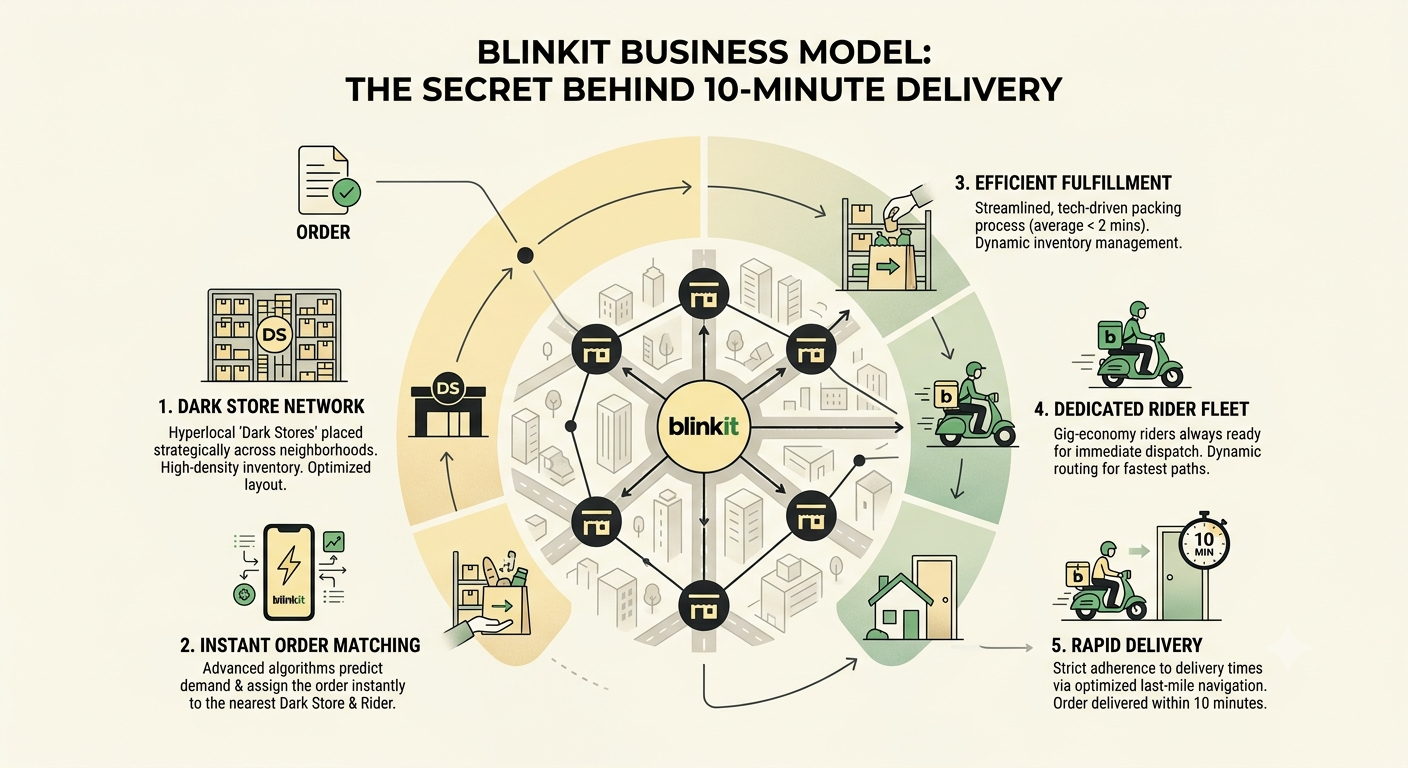
The company’s real strength lies in its network of dark stores, which are small fulfilment centres located close to residential neighbourhoods.
Unlike traditional warehouses built on the outskirts of cities, dark stores are designed to serve only a limited radius. Products are stored closer to customers, reducing travel distance and making rapid delivery possible.
But here’s what’s really interesting.
Dark stores aren’t Blinkit’s innovation.
Retailers have used warehouses for decades.
Blinkit’s innovation is where those warehouses are located.
A warehouse twelve kilometres away makes a ten-minute delivery almost impossible.
One located two kilometres away completely changes the economics.
That’s why Blinkit’s speed isn’t created on the road.
It’s created long before the order is placed.
Every new dark store is carefully chosen based on population density, purchasing behaviour, road connectivity, and expected demand.
Location isn’t just a logistics decision.
It’s a business strategy.
The Smarter the Data, the Faster the Delivery
Speed alone isn’t enough.
Blinkit also needs to make sure the right products are available at the right place and the right time.
That’s where data becomes one of its strongest assets.
Every order helps Blinkit understand customer behaviour a little better.
It learns which products sell more during weekends, festivals, cricket matches, rainy evenings, or hot summer afternoons.
Instead of reacting after demand increases, Blinkit prepares in advance.
Extra ice cream reaches dark stores before a heatwave.
Festival essentials arrive before celebrations begin.
Popular snacks are stocked before major sporting events.
This isn’t about predicting individual customers.
It’s about understanding patterns across millions of purchases.
The better the prediction, the fewer stockouts.
The fewer stockouts, the faster the deliveries.
And the faster the deliveries, the stronger the customer habit becomes.
Because that’s what Blinkit is really building.
Not an app.
A habit.
The Economics That Make Blinkit Possible
Building a business that delivers groceries in ten minutes sounds impressive.
Building one that makes money doing it is far more difficult.
This is where Blinkit’s story becomes interesting.
Quick commerce isn’t a high-margin business. Every order comes with expenses—rent for dark stores, employee salaries, inventory management, delivery costs, technology infrastructure, and customer support. If any part of the system becomes inefficient, profitability quickly comes under pressure.
So, how does Blinkit survive?
The answer lies in the fact that it doesn’t rely on a single source of revenue.
Like any retailer, Blinkit earns a margin on the products it sells. While everyday essentials like milk, bread, or flour generate relatively small margins, categories such as packaged foods, beverages, personal care products, beauty items, and home essentials contribute significantly more.
But product margins alone aren’t enough.
Every time you place an order, Blinkit may also earn through delivery or handling charges, depending on the order value and membership benefits. Individually, these fees seem insignificant. Across millions of monthly orders, they become an important revenue stream.
Then comes one of Blinkit’s fastest-growing businesses—advertising.
If you’ve ever searched for a product on Blinkit and noticed certain brands appearing at the top of the results, that’s no coincidence. Brands pay for premium visibility because Blinkit reaches customers at the exact moment they’re ready to make a purchase.
It’s similar to paying for shelf space in a supermarket but in a digital environment where customer intent is even stronger.
Membership programs like Blinkit Plus add another layer by encouraging repeat purchases through benefits such as reduced delivery costs and exclusive offers.
When all these revenue streams come together, Blinkit begins to look less like a grocery company and more like a technology-enabled retail platform.
And that’s exactly how investors see it.
Why Zomato Didn’t Buy a Grocery Startup
When Zomato announced its acquisition of Blinkit in 2022, many questioned the move.
Why would a food delivery company acquire a business that was still investing aggressively in expansion?
The answer becomes obvious when you look beyond groceries.
Both companies solve the same problem.
Not food.
Not groceries.
Convenience.
Zomato built one of India’s largest delivery networks by helping restaurants reach customers. Blinkit mastered something equally challenging—managing inventory and delivering thousands of different products within minutes.
Together, the two businesses create a much larger ecosystem where customers don’t have to think about what they’re ordering. They only think about how quickly they need it.
For Zomato, Blinkit wasn’t just another acquisition.
It was a long-term bet on changing consumer behaviour.
As people grow accustomed to instant delivery, the line between food delivery, grocery shopping, pharmacy purchases, and everyday retail continues to blur.
Owning Blinkit positions Zomato at the centre of that shift.
Why Amazon Can’t Simply Copy Blinkit
Whenever a new business model succeeds, one question inevitably follows.
If it’s so successful, why don’t larger companies just copy it?
After all, Amazon has more money, better technology, and a much larger customer base.
So why isn’t Amazon dominating quick commerce?
The answer lies in something most people overlook.
Business models are built around different priorities.
Amazon’s network was designed to maximize product variety and nationwide reach. Its large fulfilment centres are perfect for storing millions of products and delivering them efficiently over one or two days.
Blinkit’s priorities are completely different.
It sacrifices product variety to achieve speed.
Its dark stores stock only the products customers are most likely to buy immediately, allowing inventory to stay close to demand.
Trying to convert Amazon’s nationwide fulfilment model into a ten-minute delivery network would require redesigning its entire logistics infrastructure.
That’s not impossible.
But it’s certainly not simple.
This is why Blinkit’s competitive advantage isn’t technology.
It’s operations.
And operations take years to get perfect.
The Real Battle Isn’t About Speed
People often compare Blinkit, Zepto, and Swiggy Instamart based on delivery times.
Eight minutes.
Ten minutes.
Twelve minutes.
But that’s the wrong comparison.
The real battle isn’t about who delivers faster.
It’s about who can build a profitable business while delivering fast.
Speed is easy to advertise.
Profitability isn’t.
Every company can offer discounts for a few months.
Every company can attract customers through promotional campaigns.
But discounts disappear.
Efficient operations don’t.
Blinkit’s advantage comes from continuously improving its network, forecasting demand more accurately, and increasing delivery efficiency with every order.
In simple terms, every successful delivery teaches Blinkit something.
Over time, those small improvements become a competitive moat that’s incredibly difficult to replicate.
That’s why quick commerce isn’t becoming a marketing race.
It’s becoming an operational race.
And right now, that’s where Blinkit has an edge.
Convenience Is Becoming the Next Big Industry
For decades, businesses competed on price.
Then they competed on quality.
Today, they’re increasingly competing on convenience.
Customers are no longer asking,
“Where can I buy this?”
They’re asking,
“How quickly can I get it?”
That change is reshaping retail.
Blinkit has already expanded beyond groceries into categories like beauty products, electronics, pet care, gifting, stationery, kitchen essentials, and more.
This isn’t just product expansion.
It’s a signal of where the company believes the future is heading.
If customers trust Blinkit to deliver groceries in ten minutes, they’ll eventually trust it to deliver almost anything they need urgently.
That’s a much bigger opportunity than grocery delivery alone.
Awesome! Here’s the final part of your publish-ready case study. This concludes the article with a strong business perspective and a memorable ending.
The Biggest Challenge Blinkit Still Faces
Despite its rapid growth, Blinkit’s journey is far from over.
The biggest challenge isn’t attracting customers anymore but it’s making the business consistently profitable while expanding across India.
Quick commerce is an expensive business to run.
Every new city requires investment in dark stores, inventory, technology, delivery partners, and operations. Unlike traditional e-commerce, where deliveries can be grouped over longer timeframes, Blinkit has only a few minutes to fulfil each order. That leaves very little room for operational mistakes.
Customer expectations also keep rising.
Ten-minute delivery once felt extraordinary.
Today, it’s becoming the minimum expectation.
That means Blinkit has to improve continuously—not just to stay ahead of competitors like Zepto and Swiggy Instamart, but to meet the standards it has created itself.
At the same time, expansion brings another challenge.
The model works exceptionally well in densely populated urban areas where a single dark store can serve thousands of customers. Replicating the same efficiency in smaller cities, where demand is more spread out, is significantly harder.
The next phase of Blinkit’s journey won’t be about proving that quick commerce works.
It will be about proving that it can scale profitably across diverse markets.
The One Lesson Every Business Can Learn from Blinkit
Most successful businesses don’t win because they invent something entirely new.
They win because they solve an old problem better than everyone else.
Blinkit didn’t invent grocery shopping.
It didn’t invent home delivery.
It didn’t invent warehouses.
What it did was rethink the entire customer experience.
Instead of asking,
“How do we sell groceries online?”
it asked,
“Why should customers have to interrupt their day for something so simple?”
That small shift in thinking changed everything.
The company’s success wasn’t built on speed alone.
It was built on understanding human behaviour.
People value convenience.
People dislike waiting.
People are willing to pay to save time.
Blinkit built an entire business around these simple truths.
That’s why its model extends beyond groceries.
It’s about reducing friction in everyday life.
Whether it’s milk, medicine, a phone charger, or a last-minute birthday gift, the product is only part of the equation.
The real value lies in solving the customer’s problem immediately.
That’s a lesson businesses across every industry can apply.
Customers rarely buy products alone.
They buy outcomes, emotions, and experiences.
The businesses that understand this create stronger loyalty than those competing only on price.
Key Takeaways
- Blinkit transformed from Grofers by shifting its focus from online grocery delivery to instant convenience.
- Its biggest innovation isn’t ten-minute delivery—it’s the network of strategically located dark stores that makes rapid fulfilment possible.
- Data-driven demand forecasting helps ensure the right products are available before customers even place an order.
- Blinkit earns through multiple revenue streams, including product margins, delivery fees, memberships, and high-margin advertising.
- The company competes on operational excellence rather than discounts or marketing alone.
- Its biggest long-term challenge is maintaining profitability while expanding into new markets.
- Above all, Blinkit proves that modern businesses succeed by solving customer problems faster and more conveniently than anyone else.
Conclusion: Blinkit’s Real Business Isn’t Grocery Delivery
At first glance, Blinkit appears to be another grocery delivery app.
Look a little closer, and you’ll see something much bigger.
It’s a company that has fundamentally changed how people think about shopping.
Just a few years ago, waiting a day for groceries seemed reasonable. Today, waiting even thirty minutes feels slow to many urban consumers. That’s not because customer behaviour changed on its own.
Companies like Blinkit changed it.
By combining technology, data, logistics, and customer insight, Blinkit has turned convenience into one of India’s fastest-growing business opportunities. It hasn’t simply delivered products faster—it has reshaped expectations.
And that’s why Blinkit’s story matters.
This case study isn’t really about groceries.
It’s about identifying an everyday frustration, redesigning the experience around the customer, and building an entire business model to eliminate that friction.
In business, companies often believe they’re competing through better products or lower prices.
Blinkit reminds us that the biggest competitive advantage is often much simpler.
Make life easier for your customers, and they’ll keep coming back.
That’s the real secret behind Blinkit’s success.
Not ten-minute delivery.
The ability to make ten minutes feel too long to wait.